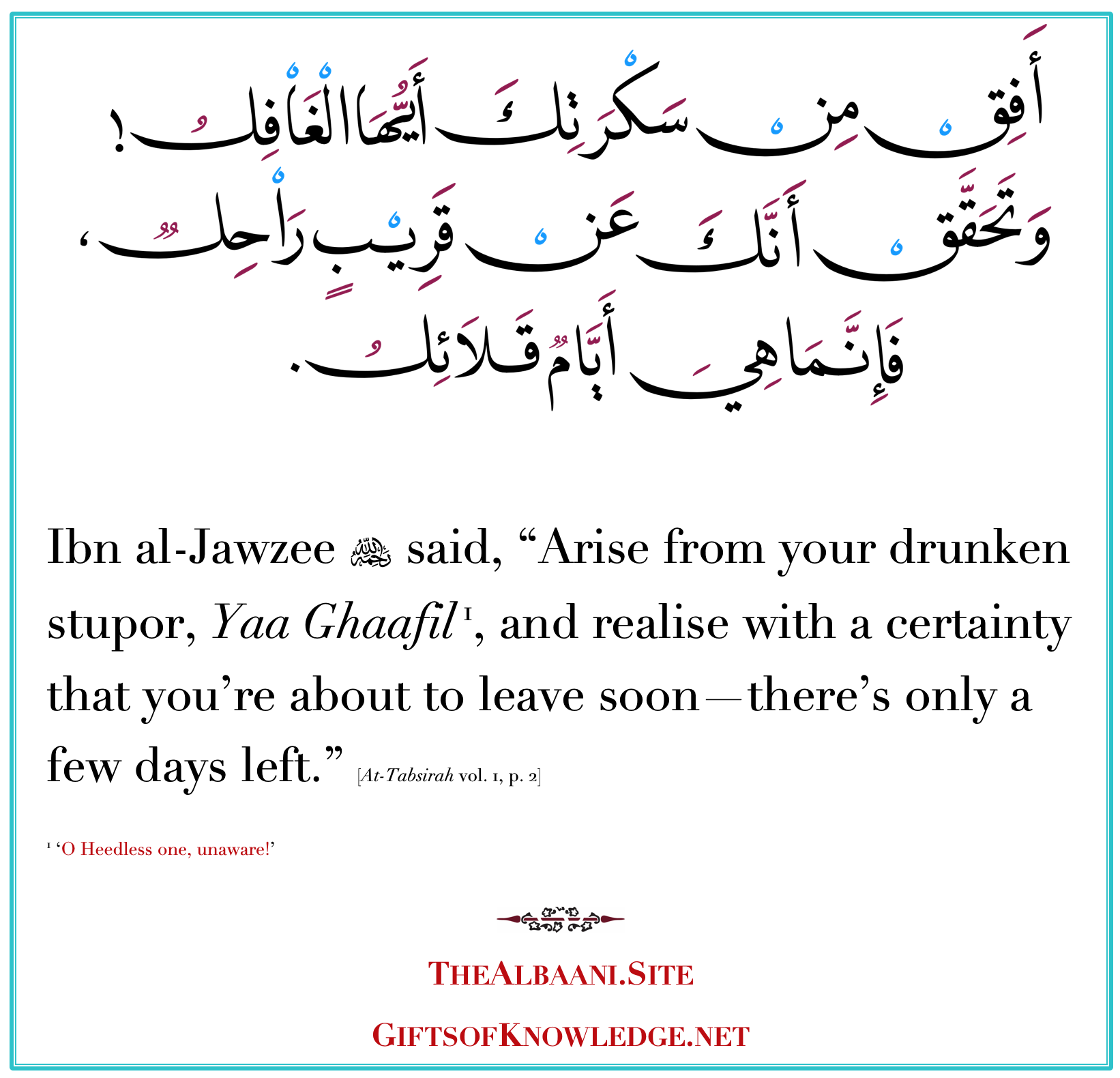
Ibn Taymiyyah’s Salaah
May 23, 2020 § Leave a comment
Al-Ḥāfiẓ al-Bazzār said, “When he would start ṣalāh and say, ‘Allāhu Akbar,’ the hearts of those present would almost be ripped out due to the awe felt in the manner that he would say it. Then when he would start praying his body would tremble such that it would shake him left and right …”
Al-Aʿlām al-ʿAliyyah fī Manāqibi Shaikhil-Islām Ibn Taymiyyah, p. 37.

A Bridge to Hell
May 22, 2020 § Leave a comment
“Uqbah bin Muslim said, ‘I accompanied Ibn ʿUmar for thirty-four months and lots of times when asked a question he would say, “I don’t know,’ and then he would turn to me and say, ‘Do you know what these people want? They want to make our backs a bridge to Hell.’”
[Ṣaḥīḥ | Authentic] | Taʿẓīm al-Futyā of Ibn al-Jawzī, pp. 85-86.
“This is Good.”
May 21, 2020 § 2 Comments
One of Ibn al-Qayyim’s students was Ibn Rajab. Imām Marʿī ibn Yūsuf al-Karmī said about him:
“He is the Shaikh, the Imām, the ʿAllāmah, the Abstemious, the Exemplar, The Blessing, The Ḥāfiẓ, The Chief Scholar, The Trustworthy, The Proof/The Authority, The Admonisher of the Muslims, the Instructor of the Scholars of Ḥadīth, Zainud-Dīn, father of al-Faraj, ʿAbdur-Raḥmān son of the Shaikh, the Imām, the Master Reciter, the Scholar of Ḥadīth, Aḥmad ibn Rajab, al-Baghdādī, ad-Dimashqī, the Hanbalī, one of the Abstemious Imāms, the Worshipping-Scholar, the Ḥadīth-Scholar, who passed away in 795ah [1393ce] in Damascus.
The gravedigger who dug out his grave said:
“Shaikh Ibn Rajab came [to me] a few days before his death and said, ‘Dig my grave there,’ and he pointed to an area. I dug it out and when I finished he lowered himself in to it and lay down, and liked it and then said:
‘This is good.’
Then he climbed out.
By Allāh it was only a matter of days until he was brought to me, deceased, being carried on his bier, so I buried him in that [very] grave.’”
Ash-Shahādah az-Zakiyyah fī Thanāʾil-Aʾimmah ʿalā Ibn Taymiyyah, pp. 49-50.
The Young Ibn Taymiyyah and the Jew
May 20, 2020 § Leave a comment
Al-Bazzār said, “And the signs of eminence and superiority could be seen in him from an early age.
That he was under [Divine] protection was clear.
Someone I trust told me from his grandmother that when the Shaikh, may Allah be pleased with him, was still a child and would go to school he would come across a Jew whose house was on the way who would put questions to him due to the intelligence and acumen he noticed in him. Ibn Taymiyyah would answer him swiftly which amazed him. This continued such that every time he went by him he would tell him things proving the falsehood of what he believed.
It wasn’t long before the Jew became a Muslim, and a good one at that.
And this was from the blessings of the Shaikh despite his young age.”
Al-Aʿlām al-ʿAliyyah fī Manāqibi Shaikhil-Islām Ibn Taymiyyah, p. 21.
The Young Ibn Taymiyyah
May 19, 2020 § Leave a comment
Al-Bazzaar said, “And Allaah made his renunciation of the world [zuhd] and its pleasures a symbol of his from a young age.
Someone I trust told me that the Shaikh who used to teach him the Quran said, “When Ibn Taymiyyah was a child, his father said to me, ‘I want you to urge and promise him that if he doesn’t stop reading and memorising I will give him forty dirhams every month,’ and then he gave me forty dirhams, saying, ‘Give them to him, because he is young and will maybe delight at that and become even more eager to busy himself in memorising and studying it, and say to him, ‘You will get the same every month.’”
But he refused and said, ‘O teacher, I promised Allaah, the Most High, that I would not take any payment for [studying] the Quran.’
So I realised that a child does not do this—except someone whom Allaah is guarding.”
Al-Aʿlām al-ʿAliyyah fī Manāqibi Shaikhil-Islām Ibn Taymiyyah, p. 44
Translation of Ibn al-Qayyim’s Madaarij as-Saalikeen
May 19, 2020 § 2 Comments
A translation of the above work is available for purchase, it comes to over 900 pages, here.
The Ka’bah of the Seventh Heaven.
May 7, 2020 § Leave a comment
وَالْبَيْتِ الْمَعْمُورِ
“And By the Much-Frequented House.”
In his explanation of Sūrah Tūr [52:4], Ibn Kathir said, “And it is the Kaʿbah for the residents of the Seventh Heaven, and it is for this reason that [on the Night Journey] Ibrahim al-Khalil [Prophet Abraham], peace be upon him, was seen there reclining with his back against it—because he is the one who built the Kaʿbah [in Mecca] on earth—and you reap what you sow.”
On Overeating and Being Obese | No. 44 | “Withhold Your Belching from Us.”
May 5, 2020 § Leave a comment
From Ibn ʿUmar رَضِيَ اللَّهُ عَنْهُ, “A man belched in the presence of the Prophet ﷺ so he said, ‘Withhold your belching from us. For indeed those who eat their fill most in the world will be the hungriest on the Day of Resurrection.’”
Abu Juhaifah [the Companion رَضِيَ اللَّهُ عَنْهُ in the above narration] said, “So I haven’t eaten my fill for thirty years.”
Silsilah, no. 343, [1260], Al-Jūʿ, p. 27.
Firefox and Chrome Add-on to Enlarge Arabic
April 29, 2020 § Leave a comment
A useful add-on I came across for Firefox and Chrome which enlarges Arabic text on websites, you can choose from a number of Arabic fonts you’d like to see a site in and also the size, find it here.
Ibn al-Jawzi’s Admonition
April 25, 2020 § Leave a comment
Ibn al-Jawzi said, “O you, wallowing in filth, for how long will you dictate—the scribes are exhausted.”
Al-Mudhish, p. 294.
On Whisperings and Pure Faith
April 22, 2020 § Leave a comment
Abū Hurairah, may Allaah be pleased with him, said, “Some of the Companions of the Prophet ﷺ came and asked him, ‘We find in ourselves something that is too awful for any of us to speak of.’ He said, ‘Do you really find that?’ They said, ‘Yes.’ He said, ‘That is clear faith.’” Muslim, no. 340.
Imām an-Nawawī said, “Meaning, ‘Your regarding talking about this as something great is clear faith, for your deeming it something great and the severity of your fear from it and from saying it, let alone believing it, only comes from someone who has completed faith unquestionably and [someone] from whom doubts and uncertainty have been driven away.
And it is said that its meaning is that Shaitān only whispers to the ones he has given up hope of misleading so he distresses and troubles them with whispers due to his inability to misguide them. So then the meaning of the ḥadīth is: the cause of the whisperings is pure faith or whisperings are the sign of pure faith.”
Al-Minhaj Sharh Sahih Muslim ibn al-Hallaaj, of an-Nawawa, vol. 1, p. 333.
We’re Fortunate if we have One
April 21, 2020 § Leave a comment
“Our Shaikh al-Ḥāfiẓ Burhānudīn al-Ḥalabī ash-Shāfiʿī said, ‘The scholars of ḥadīth who had thousands of Shaikhs …:
Aṭ-Ṭabarānī: more than 1000 Shaikhs.
Abul-Fityān: 3700.
Abul-Qāsim ibn ʿAsākir: 1380.
Abū Saʿīd ibn as-Samʿānī: 7000 Shaikhs, and this is something no one accomplished apart from him.
Ad-Dimyātī: 1300 …’”
An-Nukat al-Wafiyyah bi mā fī Sharhil-Alfiyyah of al-Buqāʿī, p. 636.
Added an Instagram Page
April 20, 2020 § Leave a comment
Added an Instagram page, please join up and distribute the posts there. Here is the link.


Does the Hadith About Whoever Dies Due to Plague Being Regarded as a Martyr Also Apply to People who Die due to Corona?
April 8, 2020 § Leave a comment

Two Rak’ahs when Leaving and Entering Your House
April 6, 2020 § Leave a comment
The previous post, now removed, was referring to travelling and not when resident. See Shaikh al-Albaani’s clarification below.
From Abu Hurairah, may Allaah be pleased with him, from the Prophet ﷺ, [who said], “When you leave your house, pray two rak’ahs—they will prevent you from an evil exit. And when you enter your home, pray two rak’ahs—they will prevent you from an evil entrance.”
As-Saheehah, no. 1323.
Al-Albaani: [The questioner says] “I read in As-Saheehah a page where there is a hadith from the Prophet ﷺ where he said, ‘When you leave your house, pray two rak’ahs—they will prevent you from an evil exit. And when you enter your home, pray two rak’ahs—they will prevent you from an evil entrance,” is that when one travels or when resident? And is it to be done constantly?”
The answer is that it seems as though it is when travelling and not when resident and if it is during travelling then naturally it wouldn’t be something that is done constantly.

Does Reciting Surah Kahf on Fridays Prevent One from Falling Under the Category of Having Abandoned the Quraan? Do I get Reward for Listening to the Quraan while Cooking?
April 4, 2020 § Leave a comment
Questioner: What is the definition of abandoning the Quraan? And does reciting Surah Kahf on Fridays prevent one from falling under the category of having abandoned the Quraan? And do I get reward for listening to the Quraan while cooking or anywhere at home?
Al-Khudair: Abandoning the Quraan is to desert reciting it and reflecting upon its meanings, taking heed from it and acting upon it, so abandoning it is done through such things. [Like I said] either by leaving off reciting it such that a long time passes without reading it. Or to leave reflecting over it, which is to abandon its meanings, taking heed from it, and pondering and benefitting from it, and to leave acting upon it, [all this] is to abandon the reason it was sent down, [and] all of this comes under the threat:
وَقَالَ الرَّسُولُ يَا رَبِّ إِنَّ قَوْمِي اتَّخَذُوا هَٰذَا الْقُرْآنَ مَهْجُورًا
“And the Messenger will say, ‘O my Lord! Lo! My people took this Qur’aan as [a thing] abandoned.’” [25:30]
Reciting Surah Kahf on Fridays does not remove one from having abandoned the Quraan, since what is meant by, ‘The Quraan,’ is the Quraan in its entirety—so one has to read it all—reciting some of the Surahs and restricting yourself to them alone, as was mentioned in the question concerning Surah Kahf, does not remove a person from having deserted it.
There is no doubt that by listening to the Quraan on the radio or from someone reciting it one obtains the reward as one does with reciting it, “And when the Qur’an is recited, give ear to it and pay heed, that ye may obtain mercy,” [7:204] so the one listening is like the one reciting, just as the person saying, ‘Aameen’ to someone’s du’aa is like the one [actually] making the du’aa.
Some people benefit more by listening than by reciting it, especially when they listen to an articulate reciter whose recitation is invigorating, for a person might recite the Quraan but his heart is preoccupied and thus he does not reflect over it but when he listens to a reciter whose recitation is enthusing it might benefit him more—but even so, he should recite the Quraan himself, and listen to it recited sometimes.
He should also vary the types of recitation he does too. At times reciting to get the reward for reading each letter, and each one has ten rewards. At others reciting so that his heart can benefit from it as ordered by reflecting over it with a slow, considered, measured, recitation of it.
The point is a Muslim needs to think about the pact he has with his Lord. The Shaikh of Islaam [Ibn Taymiyyah] says that reciting the Quraan as has been prescribed gives a believer’s heart knowledge, certainty, faith and tranquility which can only be envisaged or grasped by someone who has [actually] done so.”